Tuesday, November 26, 2013

Taking Stock- Self-Care Tuesday

If you live in the US, Thanksgiving is this week.  It can be a wonderful holiday, filled with family and food....it can also be horrific (let's be honest).  If you work as an advocate, this holiday can mark an upswing in crisis calls.  When you're already stressed out at work and in life, it can be incredibly difficult to be able to find what you are thankful for.  So rather than ask you to create a list of all of those items that you are happy about, I am going to ask you to do something a little different.  Let's just check in with how YOU are feeling today.

It would be preferable if you can do this laying down in a darkened room.  If you don't think that you will be able to do this exercise without falling asleep, that is a sign that you have a sleep deficient.  An alternative would be to do this sitting up in a chair.  Find a quiet space, close your eyes, and bring your attention to how you are breathing today. Once you feel lulled into a quiet thinking space by focusing on your breathing, start to notice what is happening in your body right now.  Starting from the top of your head, notice how your jaw, neck and shoulders are feeling.  Are you clenching your teeth?  Do you notice that one shoulder is higher/tighter than the other? Do both of your shoulders feel like they are trying to take up the space just below your ears?  Let you attention focus downwards.  How does your back feel, your torso?  Do your hips feel tight, the back of your legs, how about your feet?  Remember to keep breathing through this exercise.  If you mind starts to wander, that's okay, just try to refocus on acknowledging how your body feels at this moment.  You'll find that the deeper you breathe while doing this 'noticing' exercise, parts of your body will release a little bit of the tension.

It is all well and good to tell people to relax and practice self-care- the reality of following that recommendation can be very different. In our fast paced world most people automatically start to add a list of things that they should be doing in addition to wha
t they are managing on a day to day basis.  So if your schedule is already packed, trying to add in 3 hours a week of exercise or eating healthier seems impossible....especially if that means you would have to sleep less in order to get everything done.  Self-care has to be workable for YOU.  So if all you can do is give yourself a few moments to check in with your body, only to notice where you are holding tension, that's enough.  Noticing where we hold tension in our body is the first step to being able to figure out what we need to do in order to relax.  Sometimes releasing the tension in your shoulder isn't done by an hour on the treadmill, but by simply saying "no" to a meeting at work that really isn't important for you attend.

How often do you say "no" to requests in your life?  It can be hard to say no to begin with in high stress situations, let alone in the average day in the office.  For this next week, try to say "no" more often in the workplace.  Wait to take on new projects.  Don't add anything new to your plate.  See if that helps a little with your regular stress level.

Find places where you can delegate tasks in your work and personal life.  This can be a bit frustrating at first.  If you've ever tried to teach a 4-year-old how to make a sandwich, you've realized that it would be alot faster to just do it yourself.  But a 4-year-old that can make a sandwich will become a helpful 10-year-old eventually.   A little investment in the beginning can make a huge difference down the road.  Are there things that you are willing to let go of and let others do their own way?

Tuesday, November 19, 2013

Self-Care Tuesday- The Dangers of Minimizing

If you are an advocate you are more than likely already familiar with power & control wheels.  The power & control wheel (aka the Duluth Model) was the brainchild of the Domestic Abuse
Intervention Project (DAIP) in the 1980's, when they were trying to develop a simple yet effective way to illustrate the dynamics of abusive relationships. It's an excellent tool and a simple websearch will show you the many adaptations of the wheel (the wheel attached to this post is one adapted by the National Center for Deaf Advocacy- NCDA).  One of the spokes on this wheel is Minimizing, Denying and Blaming...which is something that both victim and perpetrator do.  The perpetrator doesn't take responsibility for their actions blaming the victim for the harm they are doing, denying that there is anything wrong in how they are reacting, and downplaying the severity of the abuse.  Likewise, victims will minimize the impact the abuse has on them, accept the blame for their perpetrator's anger, and actively tell others that there is nothing to worry about.  Working through and understanding this particular aspect of abusive relationships can be very difficult, primarily because it requires one to have a perspective of what is normal and acceptable outside of their relationship. 

The human brain likes to rank things into categories: good is better than bad, a hangnail is less painful than a papercut, strawberry jams tastes better than toe jam, and so on.  But sometimes, and especially in cases where we hear of trauma everyday, we start to rank the severity of trauma into categories of what is worthy of attention and what we feel that people should just "deal with".   We see this alot in rape culture, a victim who was coerced by threats of blackmail would be seen as weaker in character and body than a victim who fought off their stranger attacker.  The reality is that both are equally bad, and neither should be compared.  This is where we get into the dangers of minimization.  We know its bad for a victim to do, but as advocates...it is an easy trap to fall into ourselves.

How do you know if you are minimizing the trauma you hear in the workplace or in your life?  Have you ever said to yourself or someone else "You think that's bad? There wasn't even a weapon involved."  Or "well, at least no one died".  Anytime a person makes a statement of "it could have been worse" they are minimizing what happened.  There are multiple reasons for doing this but primarily it is a self-protective measure.  Everything we hear sticks to us and if we don't have healthy ways of letting all of that negativity and trauma wear off of us, we try to limit the amount that we feel.   Laura van Dernoot Lipsky writes "It only takes one extreme situation to get us started on minimizing everything else.  Minimizing is not setting priorities in our work, it is the experience of losing our compassion and ability to empathize because we are comparing others' suffering or putting it into a hierarchy.  We may also begin to minimize when we feel saturated to the point that we can't possibly let any more information in.  Instead of being able to experience the given situation for what it is, we minimize what we are hearing or seeing.  We do so in a desperate attempt to avoid hitting our breaking point.  We are literally at capacity."

The sad thing is, being GOOD at our work is what can bring us TO this point, and being AT this point, makes us BAD at our work.

How do you come back from this point?  As with anything, the first step is always recognition and awareness that a problem exists.  The second step is to seek out ways to address the problem.  This is one of the reasons why we started this Self-Care Tuesday feature and our Yoga for Advocates class, to help others seek out ways for them to address their self-care needs.  We don't intend to be an all-inclusive list of offerings and ideas, just a starting point.

What ideas to you have to help you reconnect with yourself, your life, and your passion for this work?

Tuesday, November 12, 2013

Self-Care Tuesday- Vulnerability

When you read the word "vulnerable" what is your reaction? Do you picture a person that is vulnerable? A client perhaps?  Or a person with disability, a child or someone who is elderly?  Most people picture someone that they feel is worthy of protection, but what if that word is turned towards yourself?

"You are vulnerable."

How does that change your reaction?   It most likely does.  Aversion? Avoidance? Denial? Fear? Being vulnerable is scary.  If you work with survivors, being vulnerable is something that you apply to others, rarely yourself.  Vulnerability is seen as a sign of weakness, of an inability to do our work correctly, not serving others. Or is it?  Laura van Dernoot Lipsky in her book Trauma Stewardship wrote the following about fear:

"One of the reasons it is hard for us to connect with our fear is that it makes us feel so vulnerable.  It may make us uncomfortable to recognize that we have to much in common with our clients, who are also often fearful.  If we are working to stop pandemics or racing against the clock to save the environment, we may worry that if we open the door to fear, it will completely overwhelm us, leaving us so swamped with terror that we can no longer act at all.  In short, many of us opt to disconnect from our feelings of fear because it hits a nerve of our own fragility in life.  Such denial may feel like the only viable path, but it is worth holding up to question. [...] When we acknowledge our own fear, we have an opportunity to deepen our compassion, not only for ourselves, but also for every being that has ever been afraid."

Researcher/Storyteller Brene Brown says that "vulnerability is the core, the heart, the center, of meaningful human experiences".


There is a pose that I teach often in our Yoga for Advocates class called the Sphinx.  It is fairly simple, you lie on your belly and hold yourself up on your forearms.  It looks exactly likes its namesake.  Traditionally, sphinxes are placed in front of temples symbolically as guardians of that which is sacred.  The pose is a mild backbend and your heart is exposed.  I find it very poetic that in order to protect others you must have the most vulnerable parts of yourself open to attack.


This week, I challenge you to evaluate what makes you feel vulnerable. When do you feel vulnerable? How to do you emotionally react to that realization? And do you think that there is a place in your life where honoring your vulnerability can improve how you work and who you are? 


Tuesday, November 5, 2013

Dedication: Self-Care Tuesday

Dedication: the quality of being dedicated or committed to a task or purpose.

If you do a google image search on the term "dedication" you'll see a lot of motivational (and a fair amount of demotivational) posters; each one sporting photos of a lone person running or climbing in exotic locales or of a person hard at work at their desk with the following taglines:

"If it's not worth dying for it's not worth living for"
"Excellence is bestowed upon those who tenaciously pursue one goal, each step bringing you closer to perfection."
"The dictionary is the only place where success comes before work.- Mark Twain"
"Because winning isn't everything. It's the only thing."
"If the road is easy, you're likely going the wrong way."

Part of the "American dream" ideal is that if one only works hard enough, sacrifices enough, that they will be a success.  Which sounds great and wonderful, but for those of us who work in real world, we know that that reality is far from the truth. While we may intuitively know this, many of us still fall into the trap of "if only I work hard enough".  If you are in a field where you are helping victims, underserved communities, etc that mentality of sacrifice and hard work can be amplified.  There are several problems with this mindset.  First, that dedication and success only refers to the work that we do, not the person we are.  Second, that we are "alone" in our striving for success. And third, that the fruits of our dedication is something that can be measured.

We are definitely more than just our jobs, but depending on how closely tied we are to our work, this may be difficult if not impossible to see.  This is why self-care is so important.  Self-care gives us the space to be our individual self.  And if there is anything that we should be "dedicated" to in our work, it is to make sure that we have done enough self-care that we are still effective in all aspects of our lives.  This means that you need to do something that replenishes you EVERYDAY.  Whenever you start with a self-care plan, start with the basics: sleep, rest, proper diet, exercise, and time off.  If your first response to reading that line was "well it must be nice for them if they think that everyone can do that", it is a sign that you need to evaluate the feelings behind that.  The "must be nice" view is normally denoting a feeling of envy and/or longing. 

Self-care is also something in which we aren't alone in doing.  We can't do it all....not in our lives, and definitely not in our work.  We need and rely on our family, friends, and co-workers everyday.  And while we all know that feeling of being "needed" and the weight and responsibility it carries, how often do we acknowledge our sense of "needing" other people?  It isn't a sign of weakness, but of strength.  Humankind is always at its best when it collaborates.  Where in your life can you bring in more collaboration? How can you ask others for what you need in order to assist your self-care plans?  Is it asking someone to come with you while trying a new exercise class?  Is it letting your co-workers know that you aren't available by phone on your day off?  Be comfortable in asking for what you need.

It snowed this morning. I couldn't find my gloves or my ice scraper.  It was cold and I was tired.  And even though I was sure that no one would come to the Yoga for Advocates class this morning, I still made my way to the studio.  I'm ultimately glad that I did.  People came and we had a wonderful practice.  There was a sense of community and purpose.  In the office we show program success by measured outcomes and objectives.  Grant reports want hard numbers.  Success gets measured by the bottom line. This morning I realized that success and dedication are more than that.  Sometimes the small things can show more purpose and effort than the large things.  Sometimes it isn't the quantity that is important......but the quality.

Tuesday, October 29, 2013

Where's the Exit?- Self-Care Tuesday

In a conversation with a colleague recently I heard them say "Well if I left they would be just screwed! There is no way that they could survive without me."  I let them continue to vent (as they are part of my circle of individuals who I know I can talk to privately about pressures that I am facing at work and life and they in turn can share that information with me), but I brought our conversation back to their previous statement.  Asking a little bit more about it, my colleague proceeded to tell me that they were irreplaceable at their job.  No one else knew how to do anything without their help.  They were the only ones that could fix the problems at the office.  They were needed.  This job was their life.  And while there was a note of pride in this needing to be needed by the organization, there was some underlying resentment in their tone.

I think that alot of us have been in this place at one point or another.  I know that I have.  It is partly wonderful....especially if you work in a social justice/social service field because you get extra praise from the community for the type of work that you are doing.  It is partly awful because you never get a break....from your boss, from your job, and from the person that you are at work.

I told my colleague that I personally would never want to be irreplaceable at my job because that would mean that I could never leave.  It took a couple of moments for the statement to sink in, and a few times of my colleague opening their mouth to speak and then shutting it again.

What can a person do in this situation?  What can anyone of us do?  You may not want to leave your job, but the weight of this heavy responsibility of being irreplaceable is unbearable.  I have two suggestions for you.

1# Create a hit-by-the-bus document about your position and what you do.  Not that I wish you ever to be hit by a bus, taken ill for an extended length of time, or abducted by aliens for that matter.  The hit-by-t
he-bus manual gives you space to not be at the office.  You don't need to spend a huge amount of time doing this.  One day make a list of your general task timelines on a yearly, monthly, weekly, and daily basis.  If this takes you more than 20 minutes, you are making too much of an effort.  On another day, if you are doing a task that you do on a regular basis, do a quick write-up about it.  Gradually you will have a file of different task how-tos.  There are multiple benefits to doing this: one, it can help you put into perspective the amount of work that you really do which can help when talking to supervisors about adding/changing part of your job or asking for a raise; two, you can go on vacation and know that you can send the relevant task information to those that will be covering for you when you are gone; three, people will think that you are super efficient; four, it will help you out when you can't remember what you did the last time; and five, it will train your replacement.  At the last agency that I worked for I created this document, so when I got promoted I didn't have to keep telling my replacement what they should be doing, they could consult my hit-by-the-bus manual instead.  My replacement was grateful that I wasn't ordering them around all the time and it allowed me to let go of my old position and fully embrace my new one.

2# Have a Plan B.  I want to be clear, this is not a plan on how to leave your job.  Although in doing this exercise you might find out that that is what you need to do to feel whole again.  This exercise allows you to think of what the alternatives are out there for you to do with your life.  Everything we do in life is an act of free will.  Having a Plan B can help us refocus our intentions.  It could involve a new approach to how we work, a new place to live, a different life, or even a career change.  We often get into places without a plan on how to get out of it.  Many people have experienced that moment in an exercise class where we keep pushing ourselves to get to a place where we think that we should be, rather than what our body is telling us we can be at.  Then you find yourself stuck with no idea of how you can get out of the position without hurting yourself.  The same can happen in your career, you get so caught up in trying to be who you think that you should be....and become stuck, irreplaceable, and not too happy about it.   So write down a list of 5 alternatives to what you could be doing that is different than now.  These items can range from changing something in your current position (ei. getting organized, finish the filing, looking for professional development opportunities, etc.), to fulfilling a life-long dream (ei. finishing the "novel", getting that promotion, starting that business) to even coming up with options of something that you would rather be doing than your current job (ei. race-car driver, going back to school, hot-air balloon operator, etc.).  A blend between the practical and the ridiculous is recommended.  Then share this list with someone. Sharing your dreams with others is very important. 
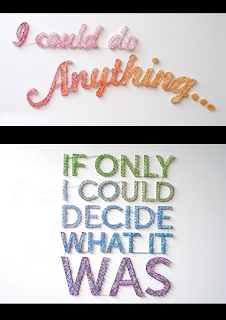
The next step in this process is to write down a list of steps you would need to take in order to make each one of these things happen. For example, if one of your goals was to go and live in a tent in Siberia for a month (don't judge me!), tasks on this goal could include: research the cost of airfare and expenses, make a budget plan to save up the money for the trip, learn how to negotiate in the local Russian dialect, watch all past seasons of Survivor and MacGyver for survival tips, find out if such a thing as Siberian Tiger repellant spray exists, etc.

Even if you never act on your Plan B list or have a need for your hit-by-the-bus manual, both of these suggestions will allow you a bit of space to breath, to refocus.   The only thing that is truly irreplaceable is the essence of you, your personality, your passion and your focus.  Connect back to that and everything else will become manageable again.

Tuesday, October 22, 2013

Mantra Smantra- Self-Care Tuesday

In this morning's Yoga for Advocates class we started our practice with a special type of breathing called "Sufi Breath".  It requires that you count out the beats of your inhales and exhales.  So if you are inhaling count "one, two"; followed by your exhale, counting "one, two".  The goal is to get your exhales to be twice as long as your inhales.  For example: inhale "one, two"; and exhale "one, two, three, four".  (Take a minute and try it)
This type of breathing does several things, most notably (like all breathing meditation and chanting methods by-the-way), it calms your parasympathetic nervous system.

Parasympathicawhatit?

Your central nervous system has three parts: the parasympathetic, which regulates your body's rest-and-digest response; the sympathetic, which regulates your fight-or-flight response; and the enteric, a net of neurons that operate independently from the central nervous system governing your gastrointestinal tract (yes, your GI tract is THAT important folks).  If someone is always stressed out, that sympathetic nervous system is on overload...the only way to calm yourself down is to do something that benefits your parasympathetic system.  Hence, why we are talking about Sufi Breath.

Practicing Sufi Breath is a gateway practice to mantra and chanting meditation.  In Sufism, this breathing exercise is part of a larger practice called Dhikr in which the practitioner will recite the name of God as a devotional act. There are similar practices within other Eastern cultures as well.  Removing any religious implications, this breathing practice can be used to focus your intentions on a mantra of your choosing.  For this breathing practice I would recommend using a two syllable word; one syllable for the inhale, one syllable for the exhale.

Here's some possibilities: joyful, worthy, patience, Friday....the list goes on and on.

The technical definition for a mantra is a word or sound repeated to aid concentration in meditation.  More commonly, especially in western cultures, the term mantra is also equated with a motto, creed, or whatever you need to tell yourself constantly to find some strength.  So what is your mantra?  What set of words can you use today to give yourself strength, support and encouragement?

Reciting your mantra can be silent or something that you express verbally.  If you feel good sitting in a lotus position and chanting "om mani padme hum",  do it.  If you are incredibly confused at what the last sentence meant, don't worry- traditional chanting as performed in the Hindu and Buddhist traditions is not for everyone.

Find something that works for you.

There is a Sufi saying in which one breath is likened to a note in a song, and breathing all day is equated with singing.  Sometimes....singing along to a song in a car is all the mantra we can handle in a day.  In any case, I hope that you can always spend each day singing, breathing, being.


Tuesday, October 15, 2013

Self-Care Tuesday- Resistance is Futile, Or Is it?

We've all been there.  It's Monday morning, you've managed to get into work on time, your clothing is right-side out, your jaw has just dropped at the sight of unread emails in your inbox....then the phone rings......  and all you can think of is...
No.
I'm not answering the phone.
No.
You can't make me.
No. No. No!

And then you pick up the phone "Good Morning....thank you for calling...."

Sometimes we let the call go to voice mail....sometimes we just hide in the breakroom, bathroom, car, or develop a highly sophisticated camouflage for our desk in the hopes that no one knows that we are there.  Having one or two days like this is fairly common....but if you feel like this every day....that's a sign of having a trauma exposure response at work.  According to Laura van Dernoot Lipsky, "when we refer to trauma exposure response, we are talking about the ways in which the world looks and feels like a different place to you as a result of you doing your work."

This begs the question: How exactly do we deal with those days where all we want to do is hide from our work?

Any scifi lover out there has heard the term "Resistance is Futile"; the catchphrase of the Borg collective on Star Trek the Next Generation.  The Borg is an alien race that assimilates other species to be drones in their collective hive.  And depending on your work environment, that can feel like many people's offices. Instead of focusing on feeling like a worker-drone, let's look at what resistance teaches us.  In yoga, resistance is a point that students come across all the time.  Its where you get into a pose and your body goes "nope, that's fine we don't need to go any further here".   Most people equate resistance with pain, but they aren't the same thing.  Pain is hot, sharp, stabbing, and your body is going to automatically react to it.  Resistance is uncomfortable, but not actively painful.   

Resistance is most often in your mind. 

In a yoga class when you come in contact with resistance, you aren't supposed to back out of it, you aren't supposed to push past it (cause you could hurt yourself), you ARE, however, supposed to just sit with it and breathe.  Once your mind settles out of its panic, your body relaxes and the resistance is gone.  How do we put this into the context of being at work and wanting to hide?  The exact same way you would with your body in a yoga class.  Don't force yourself to go ahead, especially if you interact with people on a daily basis, as your emotions will be projected and that always seems to spiral out into those around you.  Don't back out and hide.  Avoidance doesn't make the problem or your work day go away. 
Sit with it. 
Breathe. 
This is called being in the present moment. 

Sometimes the present moment sucks, sometimes it feels impossible... it is what it is.  Taking stock of what you are dealing with is the first step to letting yourself relax into that resistance.  We have both positive and negative emotions and we have to feel them all...no matter how much we don't want to.  Coming to terms with our resistance allows us to deal and react to it, it will give you space to move forward- in your body, your mind, and most importantly....tackling that awful email inbox.